Night Fighters Army Timberwolves Wolf Art Print 104th Infantry
| 104th Training Sectionalisation | |
|---|---|
 104th Division insignia | |
| Active | 24 June 1921 – twenty December 1945 1 December 1946 – nowadays |
| Country |  United States United States |
| Allegiance |  United States Army United States Army |
| Branch | Army Reserve |
| Type | Training Partition |
| Role | Training |
| Size | Partitioning |
| Garrison/HQ | Fort Lewis, Washington |
| Nickname(s) | "Timberwolf Division"[ane] "Nightfighters"[2] |
| Motto(southward) | "Null in Hell can stop the Timberwolves"[1] "We Succeed"[3] [4] |
| Engagements | World War II
|
| Commanders | |
| Commanding officer | Brigadier General Rodney J. Fischer |
| Control Sergeant Major | Command Sergeant Major Neil Pierce |
| Notable commanders | Gilbert R. Cook (1942–1943) Terry de la Mesa Allen Sr. (1944-1945) |
| Insignia | |
| Distinctive Unit Insignia |  |
The 104th Infantry Sectionalization was an infantry division of the U.s.a. Army. Today, it is known as the 104th Training Sectionalization (Leader Training) and based at Fort Lewis, Washington, as a training unit of measurement of the United states of america Ground forces Reserve.
Activated in 1921 and deployed during Earth War 2, the division saw most 200 days of fighting in northwestern Europe equally it fought through France, Netherlands, Kingdom of belgium, and western Germany, fighting back several fierce German counterattacks as it avant-garde through the theater throughout late 1944 and 1945. This was the only combat duty that the 104th Infantry Partition has served during its history. At the end of the fighting on 7 May 1945 (V-E Mean solar day), this division was in primal Frg contrary the troops of its allies from the Soviet Army.
Afterwards World War Two, this division was reorganized primarily as a grooming division for Reserve forces. Later several decades, the partitioning and so expanded its role to conducting entry-level training for soldiers of all branches of the Army in the northwestern United States. Its function and size have expanded over that fourth dimension due to the consolidation of other training commands, and the sectionalisation subsequently took charge of a number of brigades specializing in diverse entry-level training for soldiers of all types.
History [edit]
Interwar menstruation [edit]
The 104th Infantry Division was first constituted on 24 June 1921 as the 104th Division, before being organized and activated in Oct of that twelvemonth in Salt Lake City, Utah.[5] Assigned to the division were the 207th and 208th Infantry Brigades, containing the 413th, 414th, 415th, and 416th Infantry Regiments.[vi] As a unit of the Organized Reserves, the division's subordinate units were spread amid the states of Idaho, Montana, Nevada, Utah, and Wyoming.[7] In 1924 it received its shoulder sleeve insignia.[two] Populated mostly with officers through the Reserve Officers Training Corps from colleges and universities in its allotted states, the partition remained basically an officer cadre with few enlisted men, and would not run across meaning duty until World War II.[8]
Earth War Two [edit]
At the outbreak of World War Two, the 104th Infantry Division began preparing to participate in the war in Europe. The partitioning was ordered into agile military service on 15 September 1942 nether the command of Major Full general Gilbert R. Cook, and was reorganized as the 104th Infantry Division at Camp Adair, Oregon.[v] The 207th and 208th Infantry Brigades did non reactivate as office of an army-wide emptying of brigade commands within its divisions. The division was instead centered on 3 infantry regiments; the 413th,[ix] the 414th,[9] and 415th Infantry Regiments.
Order of battle [edit]
- Headquarters, 104th Infantry Partitioning
- 413th Infantry Regiment
- 414th Infantry Regiment
- 415th Infantry Regiment
- Headquarters and Headquarters Battery, 104th Infantry Sectionalization Artillery
- 385th Field Artillery Battalion (105 mm)
- 386th Field Artillery Battalion (105 mm)
- 387th Field Artillery Battalion (155 mm)
- 929th Field Artillery Battalion (105 mm)
- 329th Engineer Combat Battalion
- 329th Medical Battalion
- 104th Counter Intelligence Corps Det
- 104th Cavalry Reconnaissance Troop (Mechanized)
- Headquarters, Special Troops, 104th Infantry Division
- Headquarters Visitor, 104th Infantry Division
- 804th Ordnance Light Maintenance Company
- 104th Quartermaster Company
- 104th Betoken Company
- Military Police Platoon
- Band
- 104th Counterintelligence Corps Disengagement
- 750th Tank Battalion (attached sixteen NOV 44-23 December 44, six FEB 45-22 MAY 45)
- 784th Tank Battalion (attached 31 December 44-three Feb 45)
- 692nd Tank Destroyer Battalion (attached 29 October 44-vii MAR 45)
- 817th Tank Destroyer Battalion (fastened 1 April 45-nine JUN 45)
- 555th Anti-Aircraft Artillery Automatic Weapons Battalion (fastened 26 OCT 44-24 MAY 45)
From that point, it began training at Campsite Hyder, California every bit a partition in preparation for deployment to Europe. The division trained in the northwestern Us during the next two years, earning its name "Timberwolf Division" from its time in the area.[i] The sectionalization was the first U.S. Regular army division to exist trained to fight in night weather condition.[two] After preparation at Campsite Adair, the division participation in the Oregon Maneuver gainsay exercise in the fall of 1943.[10] [11] On 15 October 1943, Major General Terry de la Mesa Allen Sr. took control of the sectionalization.[12] He had previously commanded the 1st Infantry Sectionalisation, "The Big Red One", in North Africa and Sicily and would command the 104th during near of its time in combat.[xiii]
Europe [edit]
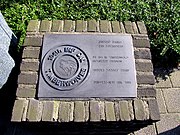
Timberwolf World War II Liberation Memorial in Zundert, Netherlands.
The 104th Infantry Partitioning sailed for the Western Front end on 27 Baronial 1944.[14] Information technology landed in France on 7 September 1944.[1] The division was assigned to III Corps of the Ninth United states of america Army, role of the Twelfth United States Regular army Group.[15] The sectionalization then organized and assembled at Manche, France before heading into combat.[16]
Joining the Battle of the Scheldt, the division moved into defensive positions in the vicinity of Wuustwezel, Belgium on 23 Oct 1944. The Timberwolves were then assigned to Field Align Sir Bernard Montgomery's Anglo-Canadian 21st Army Group under the British I Corps, within the First Canadian Ground forces, along with the U.Southward. seventh Armored Division, in order to clear out the Scheldt Estuary and open up the port of Antwerp. While the U.S. 7th Armored Partitioning was assigned static duty holding the right flank of the gains made during the failed Market Garden operation, the 104th Infantry Division was to participate in the First Canadian Ground forces'southward taking of the Scheldt. The Timberwolves travelled across France by train and debarked about the Belgian-Dutch border and waited for word to take role in a new centrolineal offensive, Operation Pheasant, taking the identify of the experienced British 49th Infantry Partitioning on the left flank and the Polish 1st Armored Partition on the right.

Combat infantrymen of Company G, 415th Infantry Regiment, 104th Infantry Partition in Cologne, Deutschland.

Soldiers of the 104th manning a Sturmgeschütz III with concrete armor, captured during the Battle of the Bulge. U.Southward. markings were added upon capture. The GI to the left is conveying a captured German StG 44.
The Americans were given responsibleness for taking 22 miles of wet, depression country from the Belgian edge to the Meuse (Maas). The width of their front was approximately 8,000 yards. Full general Allen planned to employ all three of his regiments at the same time, shoulder to shoulder. The 104th began combat operations on 25 and 26 October and began to assault the Germans, who offered varying levels of resistance. Forth the division's front, the Germans were spread thinly and did non take continuous lines of defense. Nonetheless, they did possess deadly strong points and endeavored to brand the Timberwolves' progress as time-consuming and costly as possible, making heavy use of mines, booby traps, and roadblocks. Despite this, the advance was steady, though paid for in the lives of the 104th Segmentation soldiers. Conditions were rainy, chilly, wet, and dirty. Moisture seemed to grip everything and everyone. Sleet trounce down on the troops, who went for days soaked to the peel and slimy with mud.[17] On 30 Oct, after 5 days of continuous operations the sectionalisation had pushed about 15 miles to within sight of the Marking River and had liberated Zundert, gained control of the Breda-Roosendaal Route, and overrun the Vaart Culvert defenses.[14] Leur and Etten barbarous as the sectionalization advanced to the Mark River, arriving there by 31 October.[14] A coordinated attack over the Marking River at Standdaarbuiten on 2 Nov established a bridgehead and the rest of the division crossed the river. With the Allies firmly on the northward side of the Marking River, German resistance collapsed. For the next two days, the Timberwolves pursued enemy remnants north to the Meuse. Zevenbergen was captured and the Meuse was reached on 5 November.[14] That same solar day, Full general Allen received orders from the U.S. First Army, releasing information technology from Canadian command. While the bulk of the division moved near Aachen, Deutschland, elements remained to secure Moerdijk until 7 November, when they were relieved.[fourteen] During this time, the division was reassigned to VII Corps of the U.S. 1st Army, as well part of the Twelfth Army Group.[15] By 7 Nov, the fighting in holland cost the Timberwolves 1,426 casualties, including 313 killed and 103 missing. Montgomery and the Canadian commanders sent their congratulations, and General Allen disseminated copies of their messages to his regiments and wrote a personal letter of thanks to everyone in the division, concluding with his favorite motto, "Nothing in Hell must end the Timberwolves!" As a consequence of the actions of the 104th and their Centrolineal counterparts, the Scheldt Estuary was cleared. The Royal Navy took three weeks to sweep the estuary waters articulate of mines, and in early on December 1944, the port of Antwerp was open to Allied aircraft.
While nether American control on sixteen Nov 1944, the division went on another offensive in support of Functioning Queen, taking Stolberg and pushing on against heavy resistance.[xviii] Eschweiler brutal on 21 Nov and the enemy was cleared from the area west of the Inde River, including Inden by 2 Dec 1944. Lucherberg was held against enemy counterattacks on 3 Dec, and all strongholds west of the Roer River were captured by the 23rd.[18] It took temporary command of the 60th Infantry Regiment of the ninth Infantry Division.[nineteen] During the Boxing of the Bulge, the 104th actively defended its sector nearly Duren and Merken (in German only) from 15 December 1944 to 22 February 1945. During that time, information technology was reassigned to XIX Corps of the Ninth U.s.a. Army.[15] It then moved beyond the Roer taking Huchem-Stammeln, Birkesdorf, and North Duren.[xviii] On 5 March, after heavy fighting, information technology entered Köln. Subsequently defending the due west depository financial institution of the Rhine River, the sectionalisation crossed the river at Honnef on 22 March 1945, and attacked to the eastward of the Remagen bridgehead.[18] During this time, some of the sectionalization's assets fell nether command of the 1st Infantry Sectionalisation and the 3rd Armored Division.[20] After a period of mopping up and consolidation, information technology participated in the trap of enemy troops in the Ruhr pocket. The 104th repulsed heavy attacks near Medebach and captured Paderborn on i April 1945.[eighteen] After regrouping, information technology advanced to the e and crossed the Weser River on 8 April, blocking enemy exits from the Harz Mountains. On xi April 1945 the Division was involved in the liberation of a large High german concentration army camp at Nordhausen.[21] The division then crossed the Saale River and took Halle in a bitter five-day struggle from 15 to 19 Apr.[18] The sector to the Mulde River was cleared by 21 Apr, and later vigorous patrolling, contacted the Ruddy Regular army at Pretzsch on 26 April.[18] The partition took temporary command of assets from the 69th Infantry Segmentation in early May.[19]
Casualties [edit]
- Total battle casualties: 4,961[22]
- Killed in activity: 971[22]
- Wounded in activity: 3,657[22]
- Missing in activity: 96[22]
- Pow: 237[22]
Demobilization [edit]
The division returned to the United states on 3 July 1945. Upon return, it continued the procedure of demobilization until 20 December of that year, when information technology was inactivated.[23]
During Globe War 2, soldiers of the division were awarded 2 Medals of Accolade, 14 Distinguished Service Crosses, one Distinguished Service Medal, 642 Silvery Star Medals, half-dozen Legion of Merit medals, 20 Soldier's Medals, 2,797 Bronze Star Medals, and forty Air Medals.[14] The division received 9 Distinguished Unit Citations and three campaign streamers during 200 days of combat.[14]
Training Division [edit]
The division was reactivated on one Dec 1946 in the organized reserves in Portland, Oregon. It began taking on the responsibility of holding preparation programs for new soldiers of the Us Army Reserve. In July 1948, the segmentation held its kickoff session of summer grooming. Past the end of the training, it had turned out 300 new reservists.[eight] By 1952, the sectionalisation was turning out i,500 new reservists per training camp.[viii] The division was reorganized specifically as a training division in 1959.[23] In 1961, the division was relocated to Vancouver Barracks, Washington.[23]
In 1967, the division was reorganized. As part of an army-wide initiative known every bit the Reorganization Objective Ground forces Sectionalisation plan, the division's regiments were disbanded and replaced with larger and more versatile brigades.[24] The 1st Brigade, 104th Division, activated at Vancouver Billet,[25] and the 2nd Brigade, 104th Sectionalisation activated at Pasco, Washington.[26] Meanwhile, the 3rd Brigade, 104th Sectionalisation,[27] as well equally the quaternary Brigade, 104th Partitioning both activated at Fort Lawton, Washington.[28] Each of these brigades carried the history of other historic units which fought under the 104th Infantry Partitioning in World War 2. The 104th Partitioning was then assigned the mission of conducting Ane Station Unit Training, Basic Combat Training, Advanced Individual Training, and Gainsay Back up preparation.[viii] 1st Brigade took on basic combat training, while tertiary Brigade undertook combat support training, fourth Brigade conducted combat service support training.[24]
In 1996, 3 more than brigades were added to the division's structure. The 5th Brigade, 104th Division was activated at Salt Lake City, Utah.[29] The sixth Brigade, 104th Division was activated at Aurora, Colorado.[30] The seventh Brigade, 104th Division activated at Vancouver, Washington.[31] The fifth Brigade conducted health services grooming, 6th Brigade took charge of professional development training and 7th Brigade provided preparation support to the other brigades. These units were redesignated from other training commands and put nether the control of the segmentation.[24]

Members of the 104th providing teaching to ROTC cadets, in 2011
Two boosted provisional brigades were created under the 104th Division in 1999; the 8th Brigade, 104th Division was created at Fort Lewis every bit a unit for preparation Reserve Officers' Training Corps cadets, and the 4690th United states of america Army Reserve Forces School at Fort Shafter, Hawaii was redesignated as the 4690th Brigade, 104th Segmentation, for service as a multifunctional grooming unit.[32] In 2005, the Base Realignment and Closure suggestions included the closure of the Vancouver Billet, and the 104th Division was afterwards relocated to Fort Lewis, Washington.[eight] In 2005, the current Distinctive Unit Insignia was designed under the direction of Major General Terrill K. (TK) Moffett. The 104th received its new distinctive unit insignia in 2006.[2]
In October 2007, the division was renamed the 104th Training Division (Leader Preparation). This change reflected a change in the division'southward mission, specifically training officer and non-commissioned officeholder candidates in their assigned fields.[two]
Subordinate units [edit]
As of 2017 the following units are subordinated to the 104th Grooming Sectionalization (Leader Grooming):[33]
- 1st Brigade (Leader Training)
- second Battalion, 319th Regiment (Cadet Summer Grooming)
- 3rd Battalion, 399th Regiment (Cadet Summer Preparation)
- 4th Battalion, 413th Regiment (Senior Reserve Officeholder Training Class)
- 3rd Battalion, 414th Regiment (Cadet Summer Grooming)
- 4th Battalion, 414th Regiment (Senior Reserve Officer Grooming Course)
- second Brigade (Leader Training)
- 1st Battalion, 398th Regiment (Drill Sergeants)
- 2nd Battalion, 317th Regiment (Drill Sergeants)
- second Battalion, 397th Regiment (Drill Sergeants)
- 3rd Battalion, 304th Regiment (United States Armed services Academy)
Honors [edit]
Unit of measurement decorations [edit]
| Ribbon | Award | Twelvemonth | Subordinate Elements | Embroidered | Notes |
|---|---|---|---|---|---|
 | Army Superior Unit Award | 1 January 2005 – 31 Dec 2006 | 104th Sectionalisation (Institutional Training), HQ (to include: Headquarters (less detachment), 1st Brigade, 104th Division, 1st Battalion, 414th Regiment, 2d Battalion, 414th Regiment, 1st Battalion, 415th Regiment, 2d Battalion, 415th Regiment, 3d Battalion, 415th Regiment, 1043d Training Detachment, Headquarters, 3d Brigade, 104th Partitioning, 1st Battalion, 104th Regiment, second Battalion, 104th Regiment, 3d Battalion, 104th Regiment, 4th Battalion, 104th Regiment, 5th Battalion, 104th Regiment, 1041st Preparation Detachment, U.Southward. Ground forces Regional Training Site, Sacramento, Headquarters 4th Brigade, 104th Division, sixth Battalion, 104th Regiment, 7th Battalion, 104th Regiment, 8th Battalion, 104th Regiment, Disengagement, 9th Battalion, 104th Regiment, Headquarters, 6th Brigade, 104th Division, 10 Battalion, 104th Regiment, 11th Battalion, 104th Regiment, Headquarters, 7th Brigade, 104th Division, 1st Battalion, 413th Regiment, 2d Battalion, 413th Regiment, 3d Battalion, 413th Regiment, Detachment, Headquarters, eighth Brigade, 104th Partitioning, 3d Battalion, 414th Regiment, 104th Army Band. | 2005–2006 | Permanent Orders 147-xxx[34] [35] |
Entrada streamers [edit]
| Conflict | Streamer | Year(south) |
|---|---|---|
World State of war II   | Northern France | 1944 |
| Rhineland | 1944–1945 | |
| Central Europe | 1945 | |
| World War Ii Victory | None |
Legacy [edit]

Several people who served with the 104th Infantry Sectionalization subsequently went on to achieve notability for various reasons. Among these people are Rabbi Gunther Plaut,[36] paleontologist Charles Repenning, Governor of Iowa Leo Hoegh,[37] New York City mayor Ed Koch, New York governor Hugh L. Carey, and generals John R. Deane Jr. and Bryant Moore. In add-on, actor James Yard. Snitzer was a fellow member of the 104th and died in gainsay in 1945.[38] NFL Player Bob Shaw as well served with the 104th and was awarded the Bronze Star during Earth State of war II. Screenwriter Paddy Chayefsky likewise served with the 104th during WW2.
In addition, two soldiers from this division were awarded the Medal of Honor for their service in gainsay. They are Willy F. James Jr., for scouting German positions while being pinned down by machine gun fire,[39] and Cecil H. Bolton, who led a company of men on the attack despite wounds from a mortar shell.[twoscore] Bernard Moore was a member of the 104th Timberwolves and went on to be the manager at the Waldorf Astoria Towers in New York, later promoted to the Washington Hilton in Washington, DC.[41]
Notable one-time members [edit]
- James Marshall Sprouse, World State of war II
- Edward Koch, World War Ii
References [edit]
- ^ a b c d Order of Battle, p. 410.
- ^ a b c d e "The Institute of Heraldry: 104th Sectionalisation". The Plant of Heraldry. Archived from the original on 22 June 2008. Retrieved 30 June 2009.
- ^ "Regular army Mottos". The Institute of Heraldry. Archived from the original on fourteen July 2012. Retrieved 5 Baronial 2012.
- ^ Stein, Barry Jason; Capelotti, Peter Joseph (1993). U.S. Ground forces Heraldic Crests: A Consummate Illustrated History of Authorized Distinctive Unit Insignia. Univ of South Carolina Press. p. 107. ISBN978-0-87249-963-8 . Retrieved five August 2012.
- ^ a b Wilson, p. 608.
- ^ McGrath, p. 175.
- ^ McGrath, p. 176.
- ^ a b c d e "GlobalSecurity.org: 104th Partition". GlobalSecurity . Retrieved 23 June 2009.
- ^ a b Annual, p. 592.
- ^ "Major Dates", 104th Infantry Sectionalisation National Timberwolf Association, Wichita, Kansas, 9 September 2010.
- ^ Brogan, Phil F., East of the Cascades (Third Edition), Binford & Mort, Portland, Oregon, 1965, pp. 272–275.
- ^ Cardinal Timberwolf Dates, http://www.104infdiv.org/key%20dates.htm
- ^ Order of Battle, p. 411.
- ^ a b c d e f grand Almanac, p. 570.
- ^ a b c Order of Battle, p. 415.
- ^ Order of Boxing, p. 416.
- ^ September Hope: The American Side of a Bridge Too Far by John C. McManus pp. 406–420
- ^ a b c d e f 1000 Annual, p. 571.
- ^ a b Gild of Boxing, p. 413.
- ^ Order of Battle, p. 414.
- ^ "Archives W: Robert Rust photo drove, 1930–1950". archiveswest.orbiscascade.org . Retrieved 15 March 2018.
- ^ a b c d e Army Battle Casualties and Nonbattle Deaths in Earth War II, Terminal Report (Statistical and Accounting Branch Function of the Adjutant Full general, 1 June 1953)
- ^ a b c Wilson, p. 607.
- ^ a b c McGrath, p. 227.
- ^ Wilson, p. 609.
- ^ Wilson, p. 610.
- ^ Wilson, p. 611.
- ^ Wilson, p. 612.
- ^ Wilson, p. 613.
- ^ Wilson, p. 614.
- ^ Wilson, p. 615.
- ^ McGrath, p. 228.
- ^ "U.S. Army Reserve > Commands > Functional > 108th TNG CMD". www.usar.regular army.mil . Retrieved fourteen April 2018.
- ^ "PERMANENT ORDER 147-30" (PDF). history.regular army.mil/. US Army Center of Military History. 3 June 2010. Retrieved 3 June 2014.
- ^ https://www.hrc.army.mil/asset/16333 Unit Award Alphabetize 1987– Present
- ^ "Gunther Plaut Biography". Temple Beth State of israel. Archived from the original on 21 July 2009. Retrieved 30 June 2009.
- ^ "Obituary: Leo Hoegh, 92, Civil Defense Chief for Eisenhower". The New York Times. 24 July 2000. Retrieved fifteen June 2008.
- ^ Truitt, Evelyn Mack (1977). Who was Who on Screen. New York: Bowker. pp. 429–430. ISBN978-0-8352-0914-4.
- ^ "Medal of Honour Recipients – Globe War 2 (A–F)". U.s.a. Army. Archived from the original on 3 September 2009. Retrieved 24 April 2008.
- ^ "Medal of Laurels Recipients – Globe War Two (Thou–50)". United States Regular army. Retrieved 24 April 2008.
- ^ "Bernard J. Moore'southward Obituary". The Washington Post . Retrieved 14 Apr 2018.
Sources [edit]
- McGrath, John J. (2004). The Brigade: A History: Its Organization and Employment in the U.s. Army. Combat Studies Institute Press. ISBN978-ane-4404-4915-4.
- Wilson, John B. (1999). "104th Segmentation (Training)". Armies, Corps, Divisions, and Split Brigades. United States Army Center of Military History.
- Regular army Annual: A Book of Facts Apropos the Regular army of the United States. United States Government Printing Function. 1959.
- Greenwald, Robert J., ed. (December 1945). "104th Infantry Partition". Order of Battle of the United states of america Regular army World War II: European Theater of Operations – Divisions. Paris, France: Function of the Theater Historian. pp. 410–417. Archived from the original on 11 March 2008. Retrieved 1 February 2014.
External links [edit]
- 104th Infantry Sectionalization Association
- 104th Infantry Sectionalisation Control Personnel
- Lineage at the Us Ground forces Center of Military machine History
- Timberwolves: The Story of the 104th Infantry Division
- Liberation of Achtmaal by the 415th Regiment of the 104th Inf.Div. Archived 30 September 2007 at the Wayback Car
- The Journeying of Private Galione 415B Liberator of Mittelbau Dora, Concentration Camp Nordhausen
Source: https://en.wikipedia.org/wiki/104th_Infantry_Division_%28United_States%29
0 Response to "Night Fighters Army Timberwolves Wolf Art Print 104th Infantry"
Postar um comentário